
Over 500 hectares sold!
Fully Insured by Leadway Assurance
Oil Palm Estate is a structured agricultural real estate asset engineered to combine:
Capital appreciation. Managed annual harvest income. Individually allocated land & trees.
Without demanding your time, attention, or distracting you from your primary income streams.
Oil Palm Estate Phase 2 Ogbomosho Oyo State, over 500 hectares sold!
“Press PLAY ▶️ to get the full details!”
Many Nigerians already own land.
Plots in emerging corridors.
Plots “waiting for development.”
Plots “waiting for government.”
There is nothing wrong with that.
But here is the uncomfortable truth:
Most land waits.
It appreciates slowly.
Sometimes painfully slowly.
Meanwhile:
Still waiting.
The issue is not ownership.
The issue is productivity.
In an inflation heavy economy:
Assets that only appreciate are good.
Assets that appreciate and produce?
That is strategic positioning.
Scroll. This gets clearer.
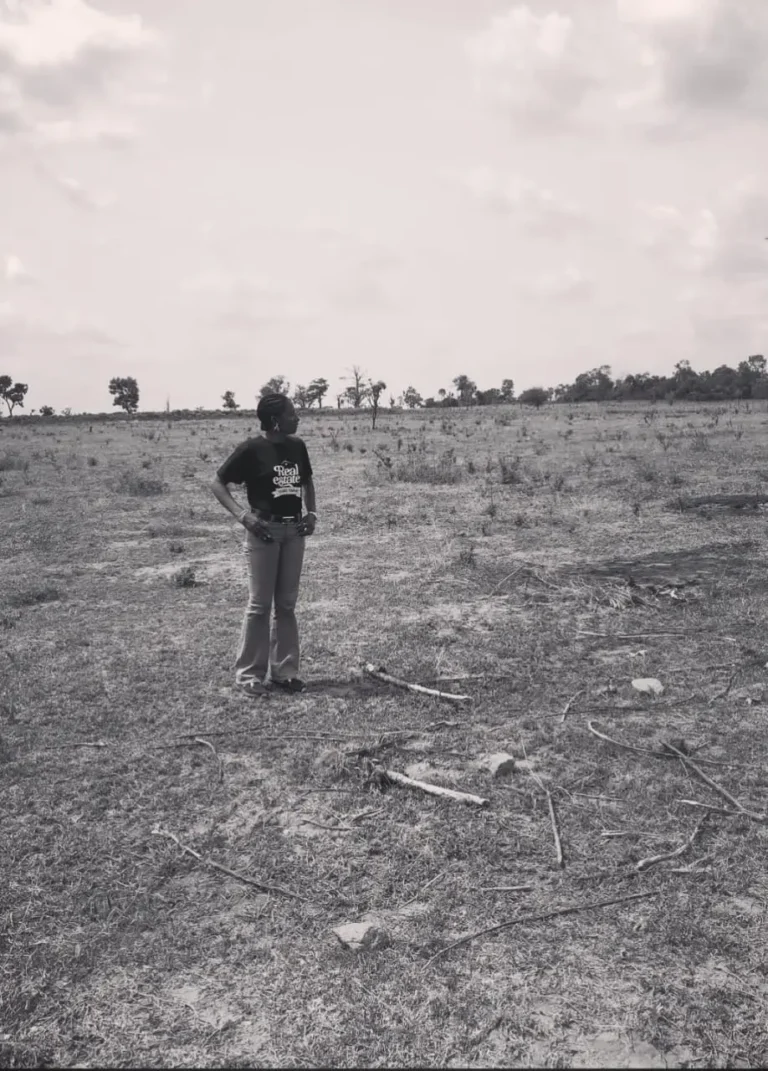
Let’s address the real question in your mind:
“Is this real?”
You have seen:
So you play safe.
You buy land and wait.
But waiting is not a strategy.
It is a position. And positions can be improved, especially in a high inflation economy.
You know inflation is rising.
You know relying on earned income alone is risky.
You know you need additional income streams.
But:
Rental property = tenant stress.
Running a farm = operational headache.
Digital agro schemes = opacity.
So you stay in the middle.
Owning land.
Hoping appreciation solves everything.
What if your land was structured to work?
Not as speculation, but as productive, documented, managed agricultural real estate.
This is exactly why this estate is structured with individual allocation, mapped documentation, and revenue share tied to actual output.
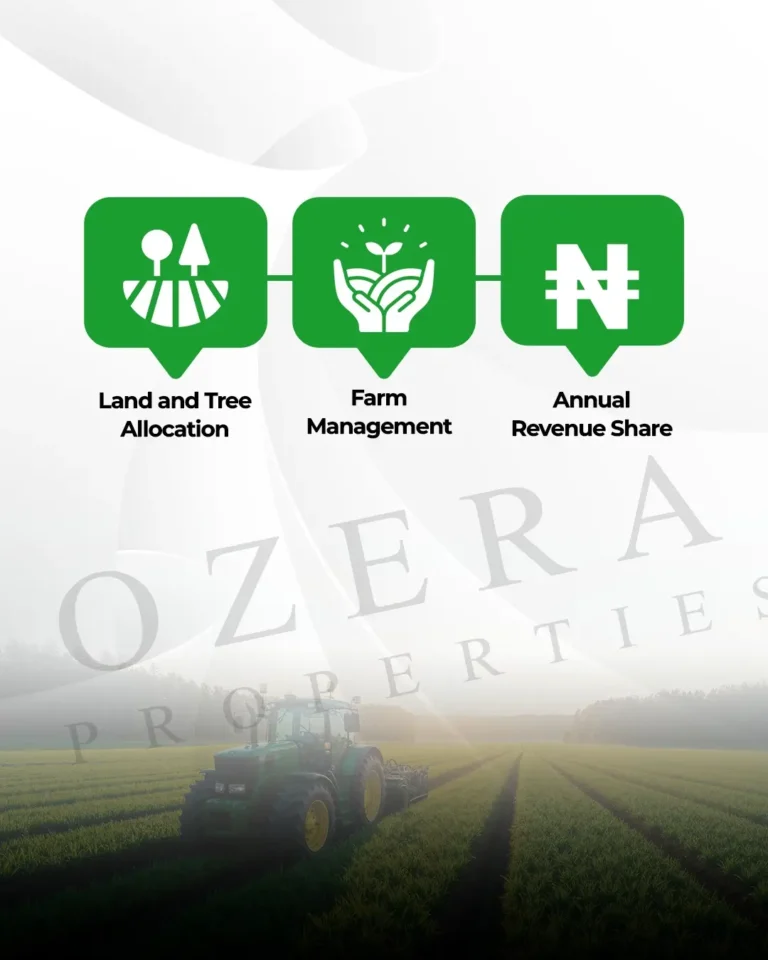
This is not pooled ambiguity.
It is not “we farm somewhere and share something.”
When you acquire an acre or hectare:
You do not:
You own productive land.
You participate in yearly income.
This is:
Landbanking + Agriculture
Capital appreciation + Revenue share
Ownership + Managed productivity
Farm Management Team: The Lead Consultant is a Chief Research Officer at the Nigerian Institute for Oil Palm Research (NIFOR). He holds a Ph.D. in Soil Fertility and serves as a major consultant and partner in agricultural projects related to oil palm, particularly in Nigeria.
In addition to structured land allocation and professional farm management, the Oil Palm Estate is protected through insurance coverage provided by Leadway Assurance, one of Nigeria’s most established insurance companies.
This ensures operational risks affecting the plantation are covered within the estate’s risk management framework.
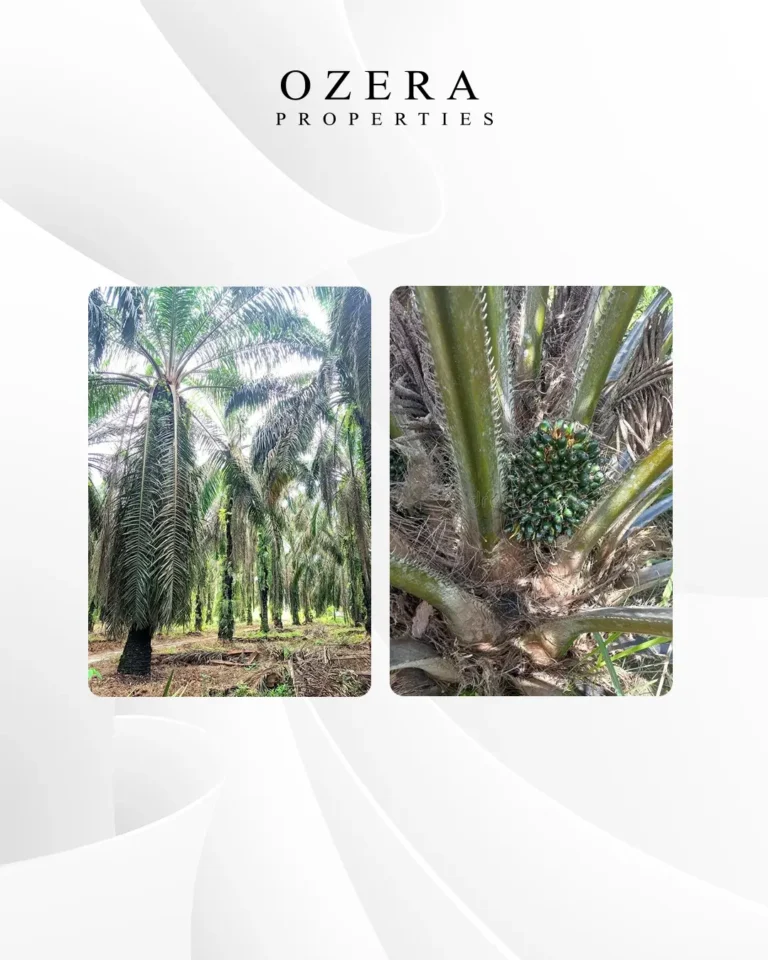
Left: Local tall palm tree
Right: F1 Tenera hybrid)
Not all palm trees are equal.
Let me say it clearly:
Not. All. Palm. Trees. Are. Equal.
Random village seedlings?
7 – 10 years maturity.
Low oil yield.
Inconsistent harvest.
We plant F1 Tenera hybrids selected for:
Your profitability is genetic.
We do not compromise there.
F1 Tenera is developed, produced, endorsed and certified by the Nigerian Institute for Oil Palm Research (NIFOR).
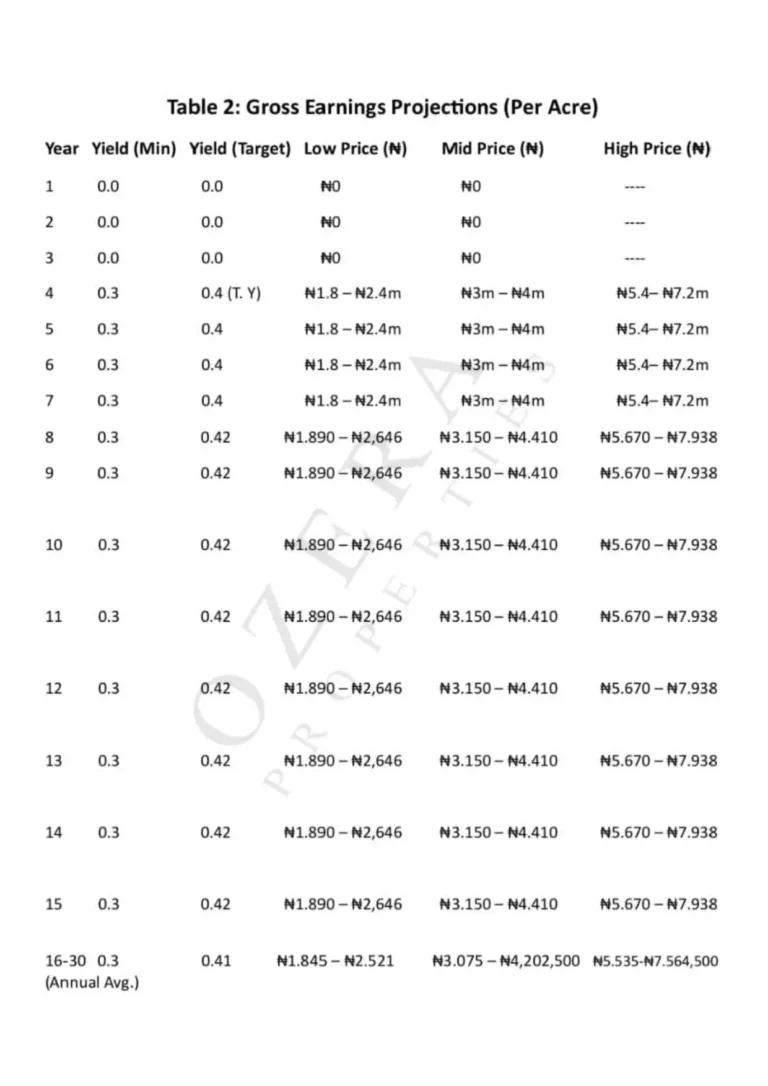
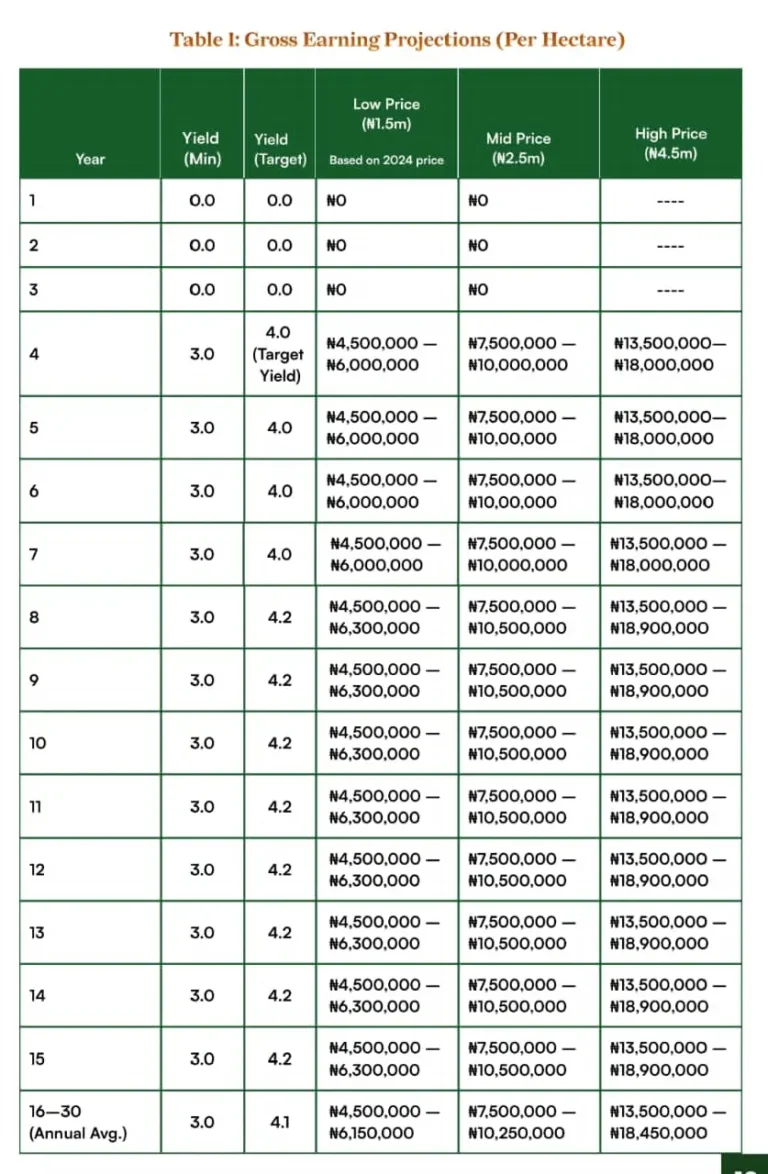
Income ranges are modeled on stable production maturity from Year 4 onward and adjusted for market driven price variability.
Trees begin fruiting in Year 3.
Meaningful income distribution begins Year 4.
Per Acre – Estimated Annual Revenue Range (Stabilized Years):
Per Hectare – Estimated Annual Revenue Range:
Below is what structured, stabilized production looks like not marketing fantasy.
All projected income ranges presented above are based on conservative yield modeling, historic palm oil pricing trends, and controlled agronomic estimates under standard management conditions.
These figures are not speculative multipliers. They reflect expected production capacity per tree, harvest maturity from Year 4 onward, and variable market price sensitivity across low, mid, and high commodity cycles.
Revenue share outcomes will fluctuate within those ranges depending on:
• Annual harvest yield performance
• Oil extraction rates
• Commodity pricing at point of sale
• Operational cost stability
This is why we present income in structured ranges, not exaggerated fixed returns.
Palm oil is a commodity asset. Commodities move. But structured yield systems are designed to remain profitable across market cycles.
Still reading? Good. You are thinking long term.
Let’s address the elephant in the room.
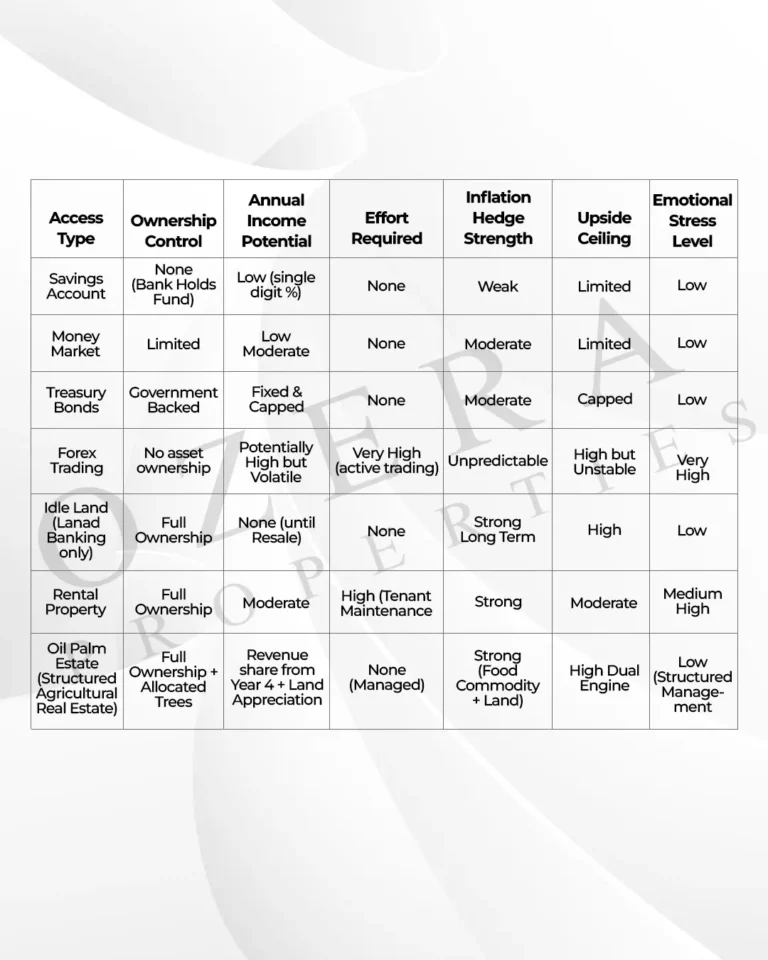
Savings | Bonds | Forex | Idle Land | Rental Apartment | Oil Palm Estate
Savings accounts preserve.
Treasury bonds cap upside.
Forex demands active skill.
Idle land appreciates silently.
Rental pays but demands attention.
Each has its place. Few combine ownership, commodity exposure, and managed yield.
Oil Palm Estate combines:
That combination is rare.
Most investors stop here. Discerning ones continue.
Oil palm follows biology:
Year 1 — Establishment
Year 2 — Growth
Year 3 — Fruiting
Year 4 — Revenue
Investor A plants today.
Investor B waits 3 years.
By the time B starts planting, investor A is approaching income distribution.
Time lost in agriculture cannot be accelerated.
There is no catch up mode.
Biology does not care about hesitation.
No obligation. Structured investor briefing first.
• Appreciation only
• No income
• Exit dependent
Productive Land (5 Years):
• Appreciation
• Harvest cycles
• Revenue share
• Yield stabilization
Both appreciate.
Only one produces.
Over 10 years?
The gap widens dramatically.
2 investors. Same capital. Different structure.
We are in Phase 2 First Batch Allocation Phase.
Benefits:
Phase 2 First Batch closing before planting April and July cycle
Structured productive land is limited.
Oil palm planting follows cycles.
Each planting cycle increases:
• Development maturity
• Tree establishment
• Estate valuation
After the April and July, 2026 planting cycle review, pricing adjusts upward.
You will either plant this year Or wish you did.
There are investments that look impressive today.
And there are decisions that still matter 20 years from now.
An Oil Palm Estate is not a short term win.
It is a long term position.
10 years from now, the trees are mature.
They are producing consistently.
Revenue is flowing annually.
The land has appreciated.
The system is functioning without daily supervision.
Now imagine explaining that to your children.
Something you planted before they even understood what investing meant.
While others spent years restarting from zero, you were compounding quietly.
Trend based investing excites.
Asset based positioning endures.
A well structured estate outlives cycles, noise, and temporary enthusiasm.
When your children ask what you built, this will not be a story.
It will be land.
Trees.
Income.
Documentation.
A functioning system. A well engineered legacy.
Ogbomosho, Oyo State.
Each investor receives legally documented land allocation tied to their purchased acreage or hectare. Documentation includes registered survey and legally recognized ownership structure in accordance with estate development guidelines.
Allocation is not verbal. It is mapped, recorded, and documented.
No.
You are allocated your specific acreage or hectare, with your corresponding trees planted within your demarcated portion.
This is not a pooled capital structure.
It is individual allocation under centralized management.
Once trees reach productive maturity (from Year 4 onward), harvested fruit is processed and sold through structured commodity channels.
Revenue is distributed annually based on the agreed revenue share structure.
Distribution is tied to actual production output, not fixed speculative returns.
The estate operates with a structured security framework including perimeter control, surveillance monitoring, and trained security personnel.
In addition, centralized estate management ensures coordinated oversight of farm operations and access control.
This is not an open bush farm.
It is a managed agricultural estate.
Yes.
Phase 1 is progressing according to agronomic schedule.
Documentation and site verification are available during inspection or scheduled investor briefing.
We build before we expand.
Oil palm trees begin fruiting around Year 3, with meaningful commercial harvest beginning from Year 4.
Income grows progressively as trees mature.
This is a biological asset.
Production follows natural growth cycles.
Palm oil is a globally traded commodity used in food production, manufacturing, and export markets.
While prices fluctuate within commodity cycles, long term demand has remained structurally strong.
This estate is positioned for production stability, not short term speculation.
Different. Bonds preserve. Productive land compounds.
If you understand structured assets, compounding systems, and time advantage, then secure your Acre or Hectare today.
Yes. The Oil Palm Estate operates under a structured risk management framework that includes insurance coverage through Leadway Assurance.
This insurance layer provides additional protection for plantation operations, reinforcing the estate’s commitment to long-term asset stability.
No obligation. Structured investor briefing first.
Ozera Properties Registered Office: No 4 M.M. Balogun Close (Formerly Ladapo Quarter), Hassan Street, Off Ikosi Road, CMD Road, Lagos State, Nigeria
Platform Disclaimers: This site is not a part of the Google, Facebook, LinkedIn, or TikTok websites. Additionally, this site is NOT endorsed by Google LLC, Meta Platforms, Inc., LinkedIn Corp, or TikTok Ltd in any way. FACEBOOK is a trademark of META PLATFORMS, Inc. GOOGLE is a trademark of GOOGLE LLC. LINKEDIN is a trademark of LINKEDIN Corp. TIKTOK is a trademark of BYTEDANCE Ltd.
Investment & Earnings Disclaimer: Real estate and agricultural investments involve risks. The Oil Palm Estate project is a long term agricultural venture. Projections regarding yields, passive income, and appreciation are based on current market data and agricultural standards in Nigeria; however, actual results may vary due to environmental factors, market fluctuations, or government policies. Ozera Properties does not guarantee specific financial returns. Please conduct your own due diligence before investing.